

Why Readers Lie About “One More Chapter”
A Scientist Investigates Sleep Deprivation and Bad Decisions

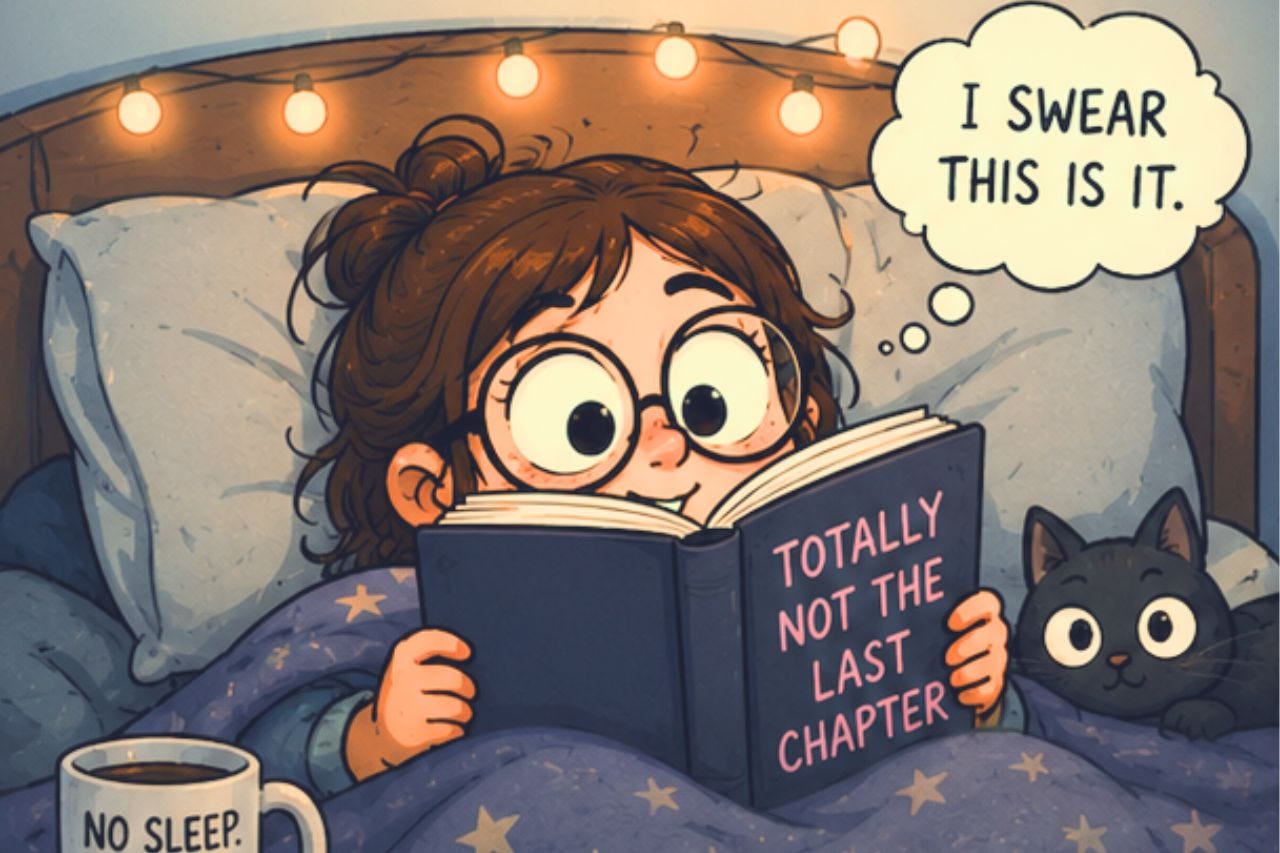
The Observation
Seven years ago I was a pharmacy manager at a hospital.
One of my staff came in late. This was unusual. She was reliable, professional, the kind of person who arrived early and made the rest of us look bad.
She looked tired. Not “bad night’s sleep” tired. Hollowed out.
I asked if she was okay.
She said yes, sorry, she’d just stayed up too late reading.
I nodded. I understood. I let it go.
Then later that afternoon I overheard her in the break room telling someone about it. The book. The scenes. The experience of reading it at midnight with her husband asleep next to her and her phone flashlight on under the covers like a teenager.
The book was Fifty Shades of Grey.
I hadn’t read it. Still haven’t. But I watched her face while she talked about it and I recognized something there. That specific expression readers get when a story has gotten into them. Lit up. A little embarrassed. Completely unapologetic.
She had gone to work exhausted at a hospital, where she was responsible for medications and dosages and people’s actual lives, because she could not put down a book.
As a pharmacist, I had questions.
The Investigation
Let’s talk about what happens to your brain when you’re deep in a book at midnight and you know you should sleep.
First: your prefrontal cortex, the part responsible for rational decision-making, is already compromised by fatigue. So the version of you making the “one more chapter” call is not your best version. She is tired and emotionally activated and not to be trusted with long-term planning.
Second: your brain is flooded with narrative transportation. This is an actual psychological phenomenon where your mind becomes so immersed in a story that it partially suspends awareness of your physical surroundings. Your heart rate syncs to the plot. Your stress response activates for fictional danger. You are, neurologically speaking, partially inside the book.
Third: cortisol and adrenaline. If the book is tense, your body is treating it like a real event. You are not relaxing. You are having an experience. Stopping mid-experience feels genuinely incomplete in a way that stopping mid-task doesn’t.
Your brain wants resolution the same way it wants to finish a song that started playing. The Zeigarnik effect. Unfinished things create cognitive tension that your brain actively tries to resolve.
One more chapter isn’t laziness or poor self-control.
It’s your nervous system doing exactly what it was designed to do.
Probably.
Except
That still doesn’t explain the flashlight under the covers.
Nobody uses a phone flashlight under a blanket because of the Zeigarnik effect. That’s not neurological urgency. That’s devotion.
So I kept thinking.
The Human Truth
Here’s what I think is actually happening at 3 AM.
The book found you.
Not every book does this. Most books are good or fine or enjoyable. You read them at reasonable hours and put them down without incident and sleep like a normal person.
But occasionally a story catches something in you. A character who thinks the way you think. A relationship that mirrors something you want or grieve or remember. A world that feels more honest than the one you have to wake up to tomorrow.
And your body knows, even if your brain won’t admit it, that morning is going to make demands. Work. Kids. The relentless administration of being a person. The book cannot come with you into all of that.
So you stay.
Not because you lack discipline. Because you found something worth being tired for.
The 3 AM reader isn’t making a bad decision. She’s making a completely human one. She found a place that felt real and she didn’t want to leave yet.
Every reader who has ever shown up somewhere exhausted and a little sheepish has also, if you ask them the right way, looked exactly like my colleague did in that break room.
Lit up. Embarrassed. Completely unapologetic.
That’s not a side effect of reading.
That’s the whole point.
The Part Where I’m Not Neutral
That colleague of mine, the one with the flashlight and the fictional billionaire and the bleary Tuesday morning, she stayed with me.
Years later I wrote a character named Sylvia. She showed up in Man for Hire, the second book in my Barista Series. I won’t say more than that, except that real people have a way of making it onto the page whether you plan it or not.
Readers who stay up too late for a book are the reason writers stay up too late writing one.
We’re all just trying to build something worth being tired for.
— the scientist, still confused but observant
If you’ve ever lied about “one more chapter,” you already know exactly what this newsletter is. Subscribe and I’ll keep explaining you to yourself.