

Someone at the Campfire Confessed to Reading the Last Page First. I Had Thoughts. Then I Had a Memory.
A scientist investigates what readers are actually looking for when they peek at the ending.

The Observation
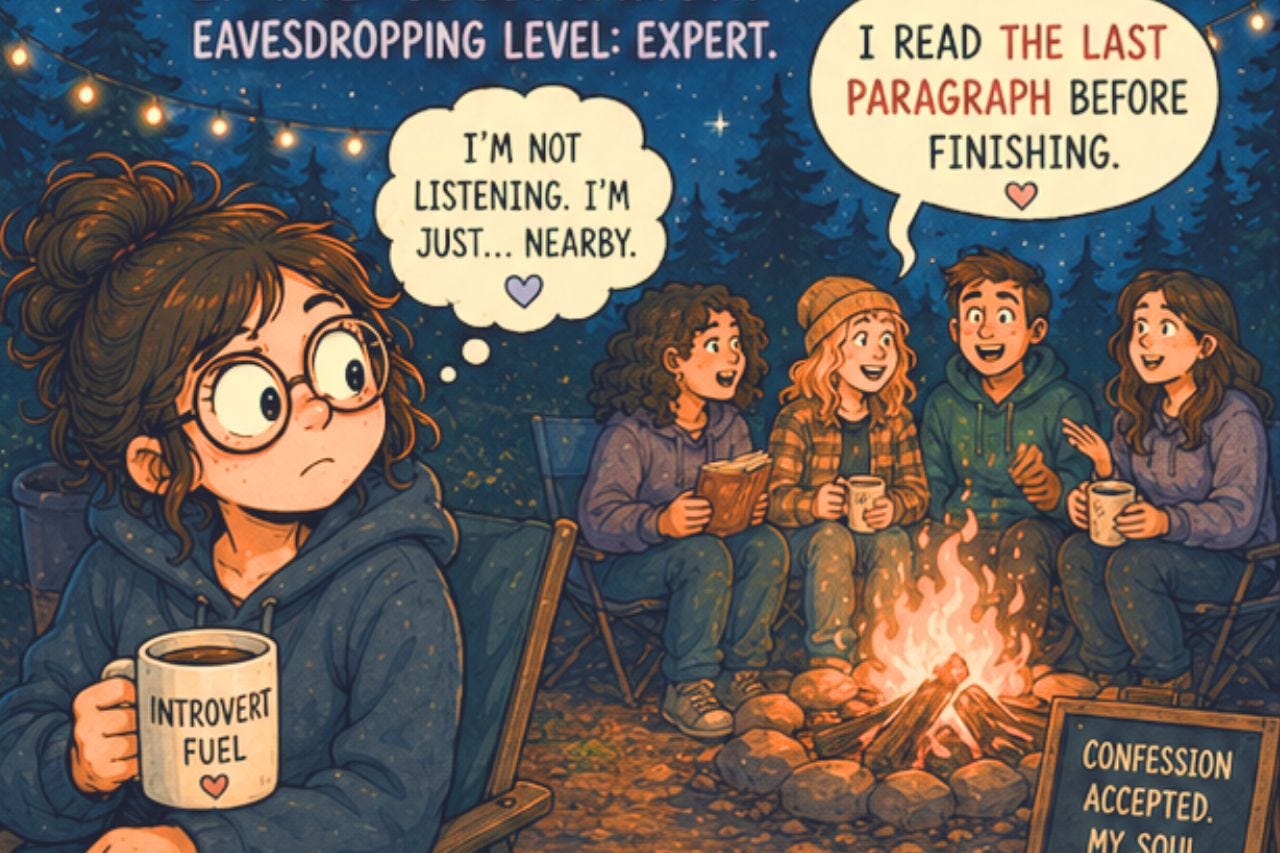
A group of us were sitting around a campfire. Comfortable and warm, the kind of night where conversations broke into smaller conversations and you lost track of which one you were in.
I’m an introvert. I had my chair pulled back from the circle (just slightly.) I was listening more than talking, which is my natural state and (honestly) my preference.
A small cluster of people nearby had started talking about books. My ears perked up. Recommendations, TBR piles, book budgets spiraling out of control. I didn’t move my chair closer. I just leaned forward to hear better.
Fine. I was eavesdropping.
The conversation was good. Then one of them leaned in toward the group and lowered her voice, clearly about to say something a little controversial.
She had read the last paragraph of her current book.
On purpose. Before finishing it.
She already knew how it ended.
I sat back in my chair. Back into the dark. I was done.
Not with my eavesdropping, of course, but with her a little bit. I had feelings and needed a few moments in my own head to process them.
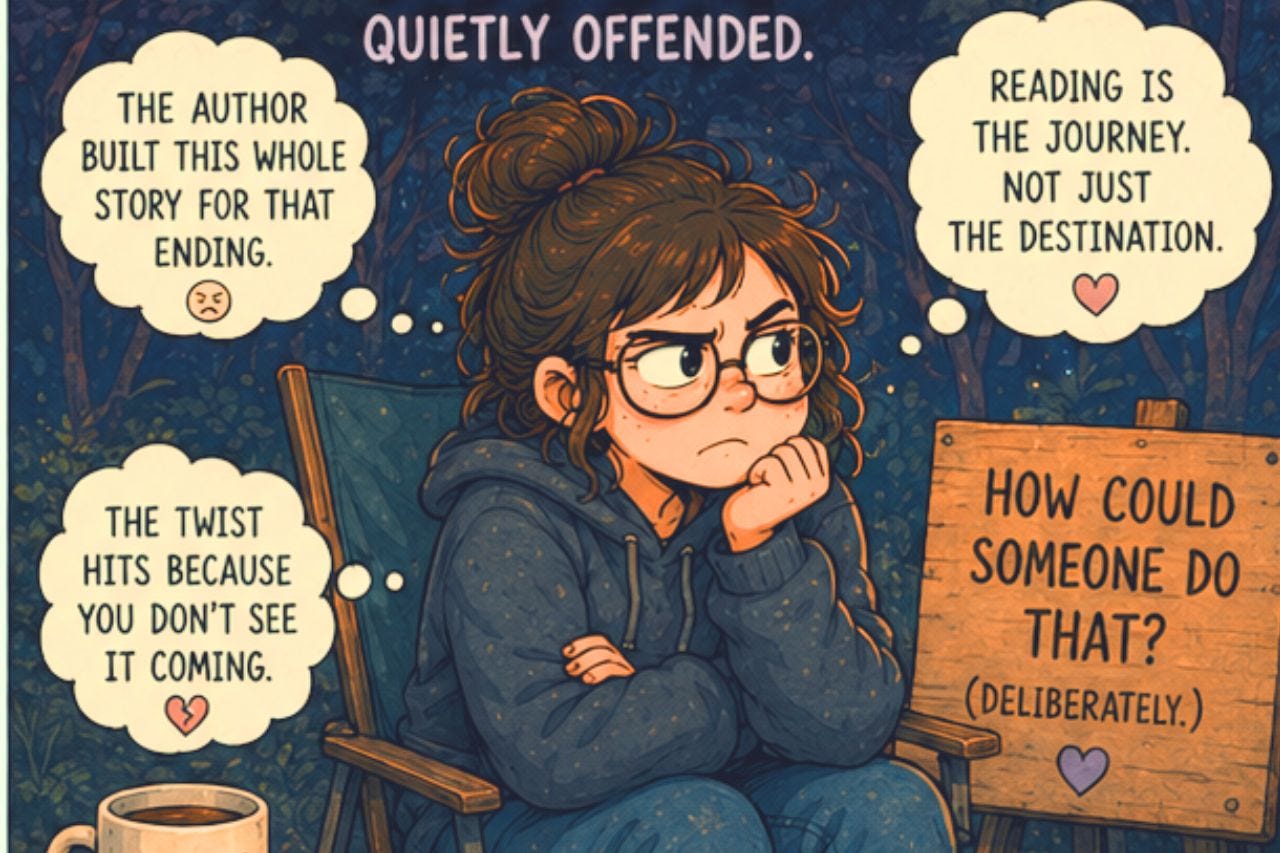
How could someone do that? Deliberately? The author spent months, possibly years, writing that thing and building toward that ending. Every chapter was crafted to lead the reader exactly where the author was going, at the exact right time. The whole emotional journey of that story depended on not knowing. The twist that landed because you didn’t see it coming. The ending that earned every page that came before it.
She just went and looked.
I read romance. I know there’s always a happy ending. I know. But there are still twists and I still don’t want them handed to me. The happy ever after means something because I watched them earn it. Because I didn’t know, at chapter twelve, whether they were going to make it. Or rather, what the architecture of them making it looked like.
I sat there in the dark being quietly offended.
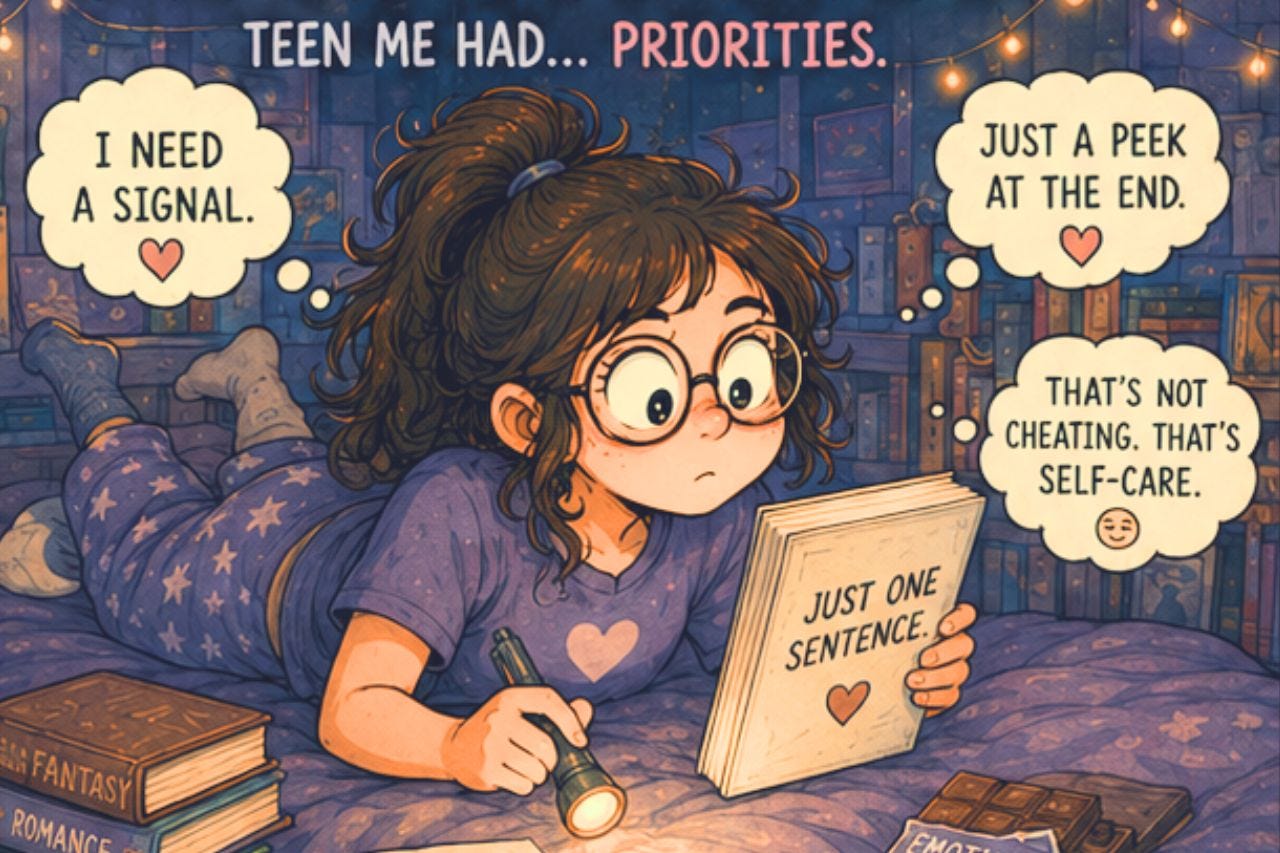
And then a fuzzy memory surfaced. It was buried so deep I had forgotten about it. There I was as a teenager, just getting into reading. Tucked in bed with whatever book I was loving.
And then I flipped ahead. Read the last sentence.
Just one sentence. I told myself it’d be no big deal. I needed something. A signal. A small look at the destination before finishing the journey.
And then I remember hat I did this more than once. I had done this all the time.
This memory had been buried until that moment at the campfire, when I found myself judging someone for doing a version of the thing I used to do.
As a pharmacist, I had questions. Mostly about myself.
The Investigation
Let’s talk about what your brain is actually doing when suspense becomes unbearable.
When you’re deep in a story, your nervous system is genuinely activated. Your cortisol rises with the tension and your heart rate tracks the plot. Psychologists call this narrative transportation, and we’ve covered it before. The more immersed you are, the more your brain treats fictional events as real ones.
Which means suspense in a book creates real anxiety.
Actual physiological stress. Your body doesn’t fully distinguish between a pretend character in danger and a person you love in danger. The threat response activates either way.
For most readers, that’s part of the point. The stress is the experience and the not-knowing is the thing, but every brains has a different threshold.
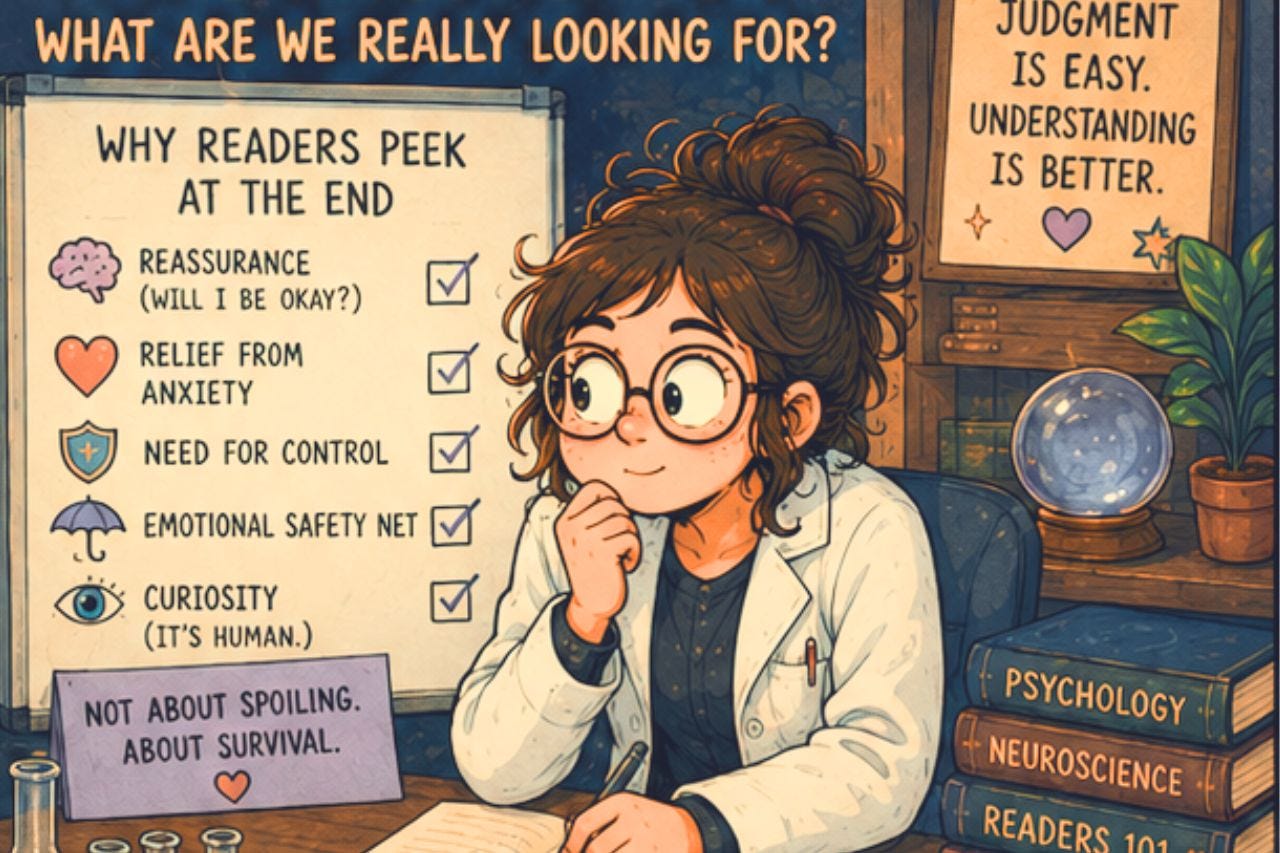
Research on what psychologists call need for cognitive closure measures how much uncertainty a person can tolerate before it becomes genuinely uncomfortable. High scorers strongly prefer clear answers over ambiguity. They find open loops distracting and want to know how things end. Not knowing creates a low-grade tension that’s hard to sit with.
There’s also something called anxiety-buffering behavior. When a threat feels too large, the brain looks for ways to reduce it without eliminating the experience entirely. Checking the last page is a version of this. You’re not abandoning the story or cheating, you’re just installing a safety net. Now you can experience the suspense from a position of knowing it comes out okay.
Or not okay. And now you’re prepared.
Studies have actually found that some readers enjoy stories more after being spoiled. Enjoy them more. How was that possible? When anxiety about the outcome is reduced, those readers can relax into the experience, pay attention to the actual writing and enjoy the journey without white-knuckling the whole ride. (Probably related to those readers who re-read the same book over and over.)
So. Physiological stress response to narrative tension. High need for cognitive closure. Anxiety-buffering behavior that turns out to improve the experience for certain readers.
That explains the last page.
Probably.
Except
I wasn’t a high-anxiety reader as a teenager.
I wasn’t reading last sentences because I couldn’t handle not knowing. I was reading last sentences because I was so far into a story I loved that I needed more. I didn’t want a spoiler and I wasn’t really looking for reassurance.
I was looking for something else.
I sat with that for a while.
The Human Truth
I think there are two completely different readers who skip to the end, and they’re doing two completely different things.
The first is the anxious reader. She needs to know it’s okay before she can fully experience it. She’s not ruining the story, but rather making it survivable for herself. Once she knows that everything will be okay, she can breathe. She can watch the author build toward it and appreciate every brick instead of dreading the wall. Probably similar to the readers who love rereading stories, but that’s the topic of a previous post.
The second reader is the one I was.
She’s not anxious, but rather, attached.
She’s so far into the world and the lives of the characters that one sentence at the end is like pressing your hand against a window. You’re still outside and you’re still going to go through the front door the right way. But for one second you just needed to feel the glass and know the place was still there. (Okay, bad analogy, but you get the point.)
That last sentence wasn’t a spoiler for me. It was like someone holding my hand. Proof that the story made it somewhere. I didn’t want the destination specifically. Instead, I was looking for evidence that there was one.
And here’s the thing about the woman at the campfire. The one I retreated from with my (embarrassing amount of) judgment.
She leaned in to tell us, lowered her voice, and was a little shy about it.
She already knew it was a confession.
Which means she knew that what she’d done was something that needed explanation. That it was controversial. Not because it was necessarily wrong, but because it wasn’t easy to justify to someone who hadn’t needed to do it. To someone like me.
Readers who skip to the end aren’t cheating.
They’re coping. Or they’re attached. Either way, they’re feeling something big enough that the normal rules of reading don’t quite contain it.
I can respect that.
I pulled my chair back into the firelight.
Mostly.
The Part Where I’m Not Neutral
I write romance. There is always a happy ever after, which is not a secret. It’s the contract.
Readers who read my genre know the destination before they start. That’s not a flaw, but rather the whole design. You’re not reading to find out if they end up together. You’re reading for the experience of watching them get there.
And yet I still don’t want you to skip ahead. Even in a genre where the ending is assumed. Where you know the couple will end up together and have their happy ending.
Why? Because the twist you didn’t see coming in chapter fifteen is still a twist. The moment the second act falls apart is still a gut punch. The thing that happens before the happy ending, the thing that makes you wonder for about forty-five minutes whether this particular couple is going to make it, that still needs to land the way it’s supposed to.
As an author, the ending isn’t the thing I protect most.
The middle is. Particularly the three-quarter twist, but really, all of it. What will force them together? What decision will they make at the midpoint?
The middle is where everything actually happens. The ending is just the exhale.
So read the last sentence if you need to. Get that reassurance you need, but just don’t skip the middle.
That’s where I live.
— the scientist, back in the firelight, mostly forgiving
Tell me honestly: have you ever read the last page first?
And if you have, was it for reassurance or something else?
If you’ve ever done something a reader isn’t supposed to do and felt a little sheepish about it, subscribe. I’ll keep explaining you to yourself.
I love how you explained this! As an author, I completely agree about guarding the middle instead of the HEA. As a reader, it's almost guaranteed I'll peek at the ending to make sure 1) the dog survives, 2) who to root for in a love triangle. Then I'm good to go!